What Counts as a High-Value Pharmaceutical Shipment?
A high-value shipment is defined by more than the price of the product inside it. Value here combines the commercial worth of the cargo, the clinical importance of getting it to patients, and the difficulty of replacing it if it is lost.
Typical high-value cargo includes:
- Biologics, cell and gene therapies, and other temperature-sensitive specialty drugs
- Oncology treatments and other products where a delayed or spoiled batch directly affects patient care
- Vaccines and large commercial batches that represent a meaningful share of a market’s available supply
- Products with narrow stability windows, where a short excursion can compromise the entire load
At commercial scale, these products move in far larger quantities than they did in trials. A container can carry as much as 5 European or 4 US pallets and over 2,500 kg of product. That much value in one container makes the shipment a concentration of risk worth managing deliberately.
Why Risk Increases at Commercial Scale
Moving one temperature-sensitive shipment is demanding. Moving hundreds of them a year, across continents and modes of transport, is a different problem entirely. Several pressures compound as volumes grow.
More value sits in each shipment. A single excursion at commercial scale can write off far more product than the same failure would in a clinical shipment. Industry estimates put annual pharmaceutical losses from temperature excursions and cold chain failures at around $35 billion, and a large commercial batch can account for a significant slice of that in one event.
More lanes mean more handovers. Reaching global markets multiplies the number of partners, transfer points, and border crossings a product passes through. Each handover is a moment where a container can sit on a hot tarmac, wait through customs, or lose access to power. Airports are a particular pressure point: according to the International Air Transport Association (IATA), over half of temperature excursions occur there, during ground handling and delays.
Longer routes test the limits of protection. Commercial distribution often means longer, multimodal journeys, including air-to-ocean transitions to reach distant markets economically. A shipment can spend days in transit and dwell time before it reaches its destination, well beyond the runtime many containers can hold without external power.
Repackaging introduces new failure points. When a shipment switches transport modes, moving cargo between containers exposes the product to ambient conditions and adds handling steps. Every transfer is a chance for a temperature excursion or a documentation gap.
Supply continuity is on the line. A lost commercial batch can also create a stockout that interrupts treatment for the patients waiting on it. That is the outcome pharmaceutical companies work hardest to avoid.

How to Reduce Risk in High-Value Pharmaceutical Shipments
Risk at commercial scale becomes manageable when protection is built into the shipment from the start. The most effective measures share a common logic: reduce dependence on conditions outside the shipper’s control.
Match the container to the shipment. Sending a half-empty container wastes capacity and CO₂; overloading a small one leaves product unprotected. Right-sizing capacity to the actual volume keeps protection consistent without paying for space that is not used.
Choose long independent runtime. A container that holds temperature for days without external power removes the dependence on plugs, cold rooms, and reliable infrastructure at every node. Delays stop being emergencies when the container can outlast them on its own.
Reduce infrastructure dependence. Many lanes into growing markets lack dependable temperature-controlled facilities at every step. Protection that travels with the container keeps risk steady across strong and weak lanes alike.
Keep the product in one container across modes. A container that moves by air, road, and ocean without repackaging removes the handling and exposure that come with every transfer.
Monitor in real time and act early. Continuous visibility into temperature and location turns a developing problem into an intervention while the shipment is still moving. The value of monitoring is in the decisions it makes possible before arrival.
Use reusable, non-dangerous-goods equipment. Reusable containers that are classified as non-dangerous goods simplify handling, reduce paperwork at borders, and lower the environmental cost of large, repeated shipping programs.
How SkyCell Supports High-Value Shipments at Commercial Scale
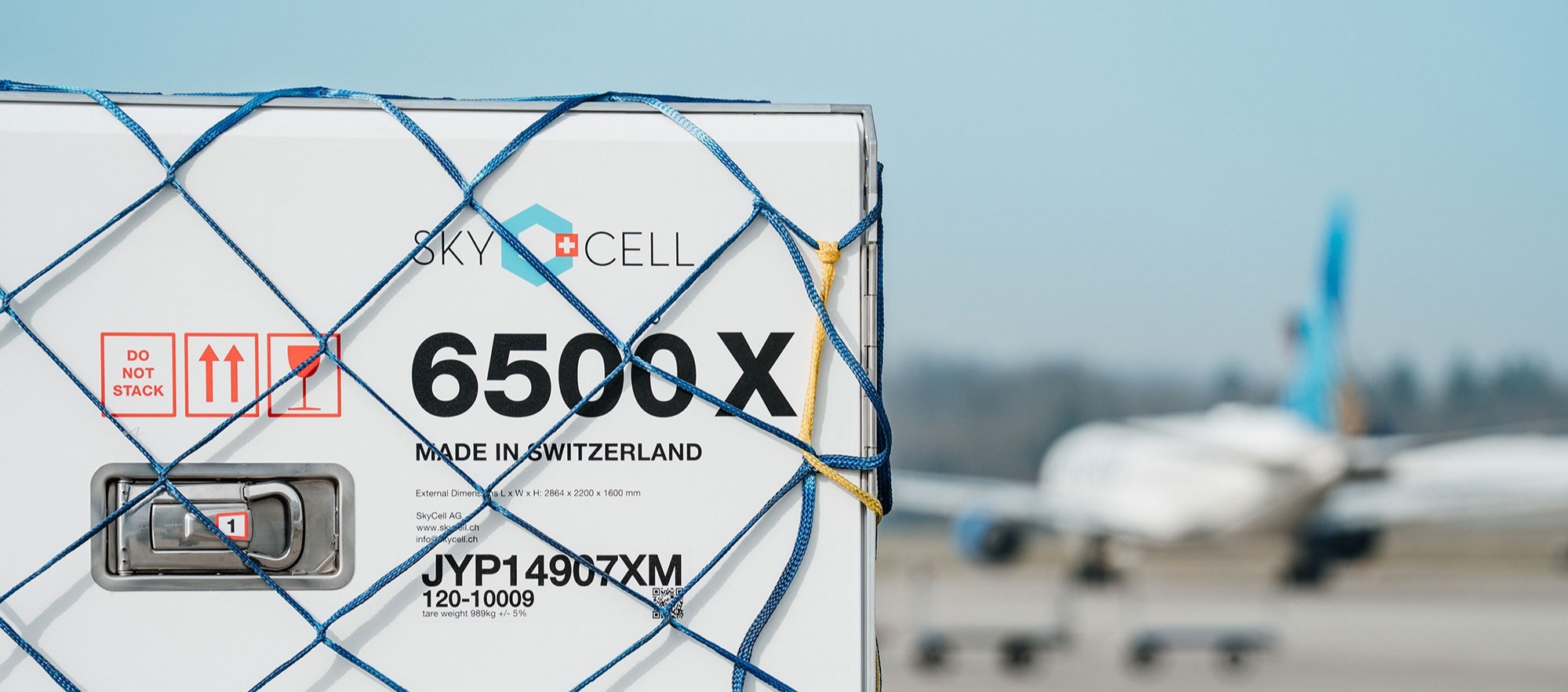
SkyCell’s hybrid containers combine active and passive cooling to hold temperature for long periods without external power. The 6500X, SkyCell’s multi-pallet hybrid container, is built for exactly the commercial-scale shipments described above. Its specifications are verified from SkyCell’s product data.
- Capacity for commercial volumes. The 6500X carries up to 5 European or 4 US pallets, with a maximum payload of 2,500 kg and 6.6 m³ of usable volume, so large batches move in a single protected unit.
- 300 hours of independent runtime. The container maintains its internal temperature for 300 hours at an external temperature of +20°C, with no external power required. It holds cold set points of +2°C to +8°C or controlled room temperature of +15°C to +25°C.
- Protection across extreme conditions. The 6500X is rated for external conditions from −30°C to +60°C, covering the tarmac heat and cold-room extremes a global route can present.
- True multimodal transport. The container is designed to move across land, air, and ocean, including air-to-ocean transitions, without repackaging the product between modes.
- Low tare weight. The 6500X has a tare weight of 877 kg, which SkyCell reports as the lowest in its class. That reduces the weight penalty of large-format protection, which matters for cost and CO₂ on high-volume programs.
- Real-time monitoring through Validaide. Integrated Validaide technology automates temperature logging and provides real-time visibility, so teams can act on a developing issue while the shipment is still moving.
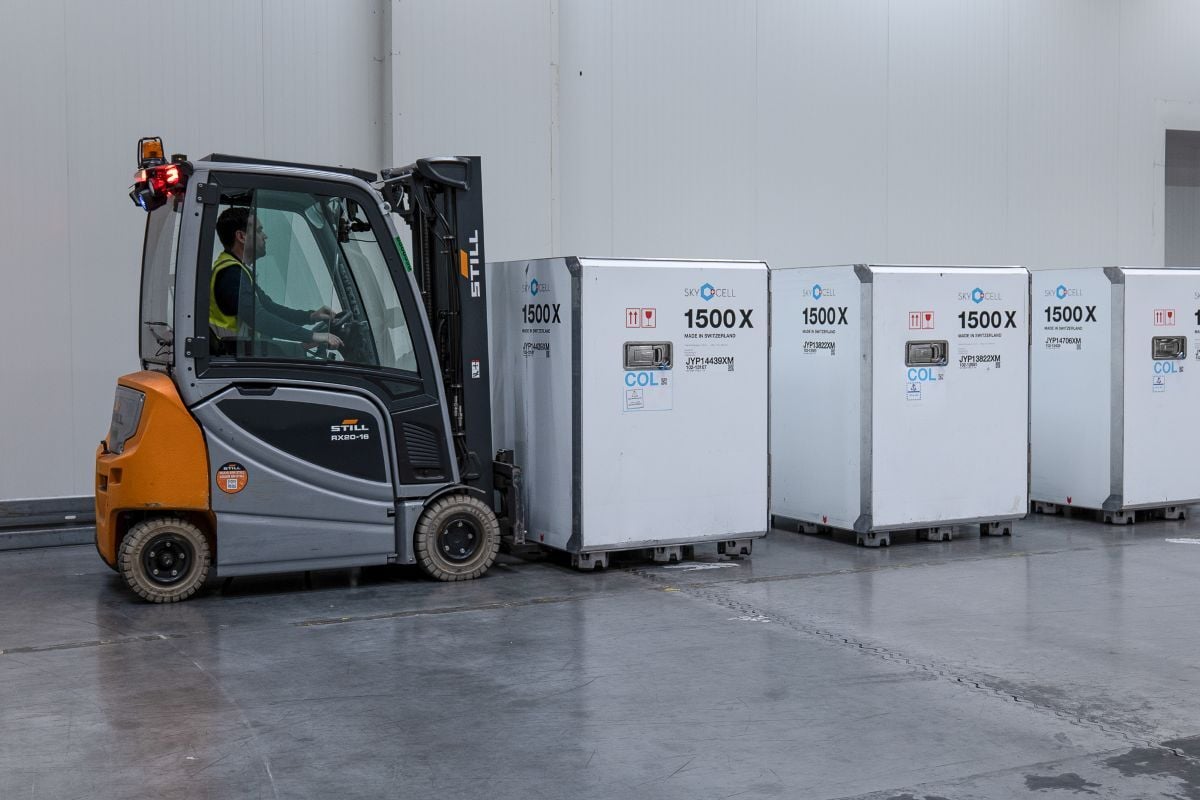
- Right-sizing with the Perfect Duo. The 6500X pairs with the smaller 1500X container so shippers can match capacity to shipment volume, reducing empty space and unnecessary emissions.
- Reusable and non-dangerous-goods by design. The container is reusable and classified as non-dangerous goods, which simplifies handling and supports lower-emission shipping at scale.
SkyCell operates on a mission to eliminate medicine loss and drive net-zero CO₂ emissions in pharma logistics, and its containers are supported by certifications including DO-160, ISO 27001, ISO 9001, GxP, GAMP5, and FDA 21 CFR compliance.
What This Means for Pharmaceutical Companies
Scaling a product into commercial distribution changes the risk profile of every shipment. The value concentrated in a single load rises, the number of lanes and handovers grows, and the routes get longer and more complex. Protection that depends on external infrastructure becomes harder to sustain across all of them.
Building protection into the container itself gives pharmaceutical companies a consistent baseline of risk, whether a shipment travels a mature European lane or a developing route with limited cold chain infrastructure. That consistency is what lets a company design its supply chain around business goals, such as reaching new markets, rather than around the operational limits of its packaging.
Summary
- High-value pharmaceutical shipments combine high commercial worth, clinical importance, and difficulty of replacement, and they move in much larger volumes at commercial scale than in clinical trials.
- Risk rises at commercial scale because more value sits in each shipment, more lanes create more handovers, routes get longer and multimodal, repackaging adds failure points, and a lost batch can interrupt patient supply.
- Industry estimates put annual pharmaceutical losses from temperature excursions and cold chain failures at roughly $35 billion.
- Risk is reduced by matching container capacity to shipment volume, choosing long independent runtime, reducing infrastructure dependence, avoiding repackaging across modes, monitoring in real time, and using reusable non-dangerous-goods equipment.
- SkyCell’s 6500X hybrid container carries up to 5 EU or 4 US pallets and 2,500 kg, holds temperature for 300 hours at +20°C with no external power, is rated from −30°C to +60°C, moves across land, air, and ocean without repackaging, weighs 877 kg tare, and provides real-time monitoring through Validaide.
- The 6500X pairs with the 1500X in the Perfect Duo to right-size capacity, and is reusable and classified as non-dangerous goods.