Why Global Pharma Airfreight Is Operationally Challenging
Global pharmaceutical airfreight involves significantly more complexity than domestic cold chain logistics.
Shipments may encounter:
- Airport congestion
- Customs inspections
- Multiple handovers
- Infrastructure variability
- Delayed transfers
- Extreme ambient conditions
At the same time, biologics and specialty medicines often have:
- Narrow stability ranges
- Low tolerance for excursions
- High product value
- Strict compliance requirements
This means the “best” pharmaceutical container is not simply the coldest or most precise. It is the system best able to tolerate disruption across the entire journey.
What Pharma Companies Should Evaluate
Autonomous Runtime
Runtime determines how long a shipment can remain within validated temperature ranges without requiring external intervention.
Long runtime is critical during:
- Airport dwell
- Missed connections
- Customs delays
- Infrastructure interruptions
Systems with insufficient runtime may become vulnerable during prolonged disruption.
Pharmaceutical companies increasingly prioritize runtime because global airfreight delays are common rather than exceptional.
Infrastructure Dependency
Some container systems rely heavily on:
- Plug access
- Charging infrastructure
- Reefer trucks
- Temperature-controlled storage
On global airfreight lanes, these resources may not always be available when needed.
Reducing infrastructure dependency improves operational resilience, especially on:
- Emerging-market routes
- Congested airport hubs
- Long-haul international lanes
Excursion Resilience
Low excursion rates are one of the strongest indicators of operational cold chain performance.
Excursion resilience depends on:
- Runtime duration
- Thermal recovery after opening
- Reduced handling exposure
- Visibility during delays
- Operational coordination
This is why pharmaceutical companies increasingly evaluate real-world performance rather than laboratory specifications alone.
Visibility and Operational Intelligence
Modern cold chain systems increasingly require more than temperature monitoring.
Pharmaceutical companies increasingly look for:
- Real-time shipment visibility
- Airport dwell monitoring
- Predictive risk analysis
- Lane intelligence
- Intervention coordination
Visibility becomes especially important during operational disruption, where rapid response can prevent excursions before thermal protection is exhausted.
Sustainability and Infrastructure Efficiency
Cold chain sustainability is increasingly tied to operational efficiency.
Systems that reduce:
- Reefer truck dependency
- Cold storage requirements
- Emergency intervention
- Product loss
can significantly reduce total cold chain emissions. This is becoming increasingly important as biologics distribution scales globally.
How Different Temperature-Controlled Container Systems Compare
Different pharmaceutical container systems approach global airfreight resilience differently.
| Container Approach |
Example Providers |
Main Strength |
Main Operational Consideration |
| Active Containers |
Envirotainer RAP/e2, CSafe RKN |
Precise powered temperature control for long-haul transport |
Dependence on charging infrastructure and airport plug availability |
| Passive Containers |
va-Q-tec passive solutions, Sonoco ThermoSafe |
Simpler infrastructure requirements and straightforward handling |
Runtime may be more limited during prolonged operational disruption |
| Hybrid Containers |
SkyCell 1500X, SkyCell 6500X |
Long autonomous runtime with low infrastructure dependency |
Greatest value achieved on complex global pharma lanes |
As pharmaceutical supply chains become more operationally complex, many companies increasingly evaluate how these systems perform during disruption rather than only during planned transit conditions.
Why Hybrid Systems Are Growing in Global Pharma Airfreight
Hybrid systems are increasingly used for biologics and complex international lanes because they combine:
- Long autonomous protection
- Reduced infrastructure dependency
- Lower handling requirements
- Operational resilience during delays
This is particularly valuable in environments where:
- Plug access is inconsistent
- Airport congestion is high
- Delays are difficult to predict
- Infrastructure quality varies between regions
For many pharmaceutical companies, reducing dependency on external cold chain infrastructure improves both resilience and operational flexibility.
How SkyCell Approaches Global Pharmaceutical Airfreight
SkyCell combines temperature-controlled containers with operational visibility, lane intelligence, and coordinated intervention capability designed specifically for pharmaceutical logistics.
Long Autonomous Runtime
SkyCell hybrid containers maintain validated temperature ranges without requiring external power during transit.
- SkyCell 1500X. 270+ hours runtime
- SkyCell 6500X. 300+ hours runtime
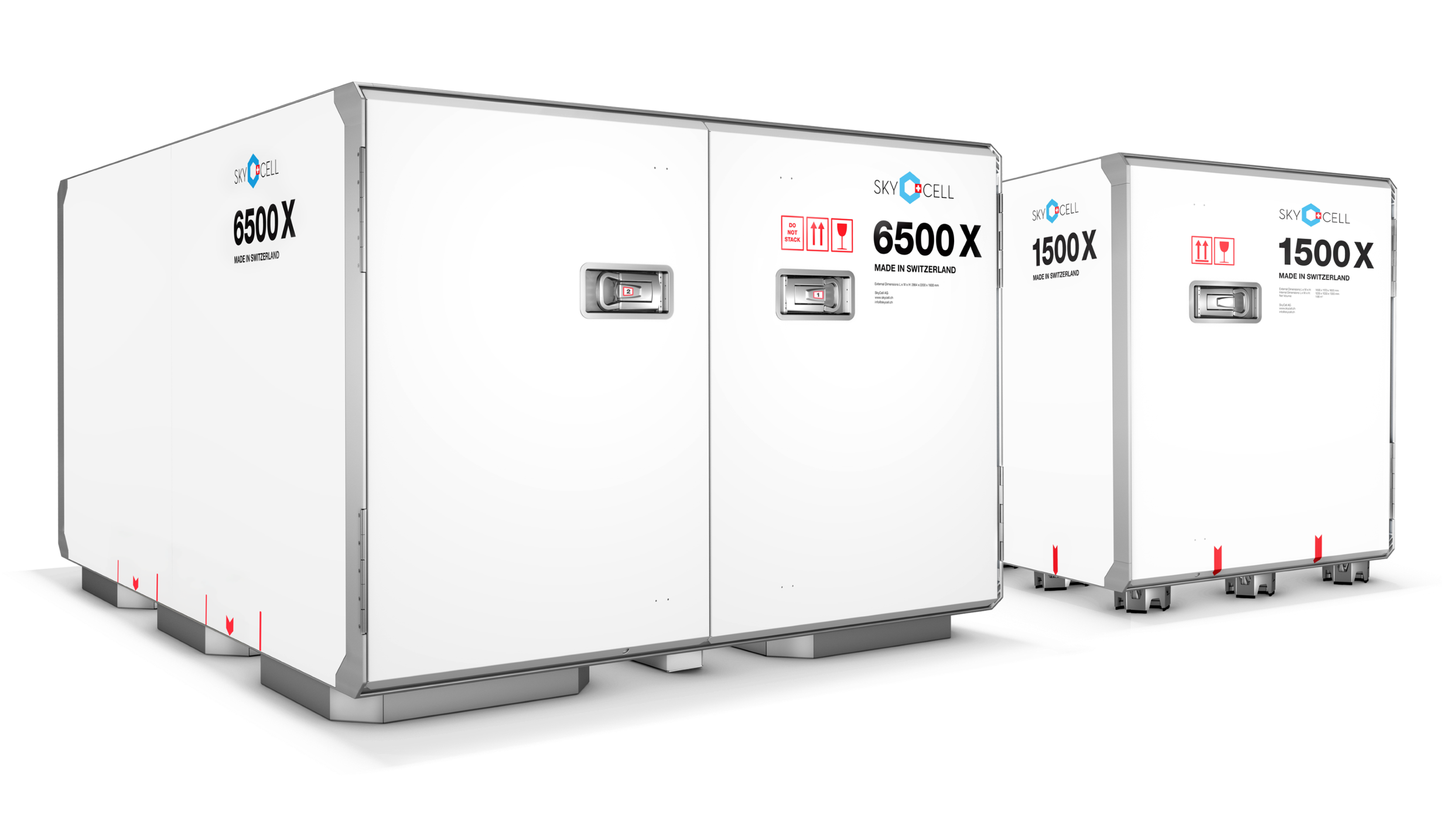
This extended runtime helps shipments tolerate:
- Airport dwell
- Customs delays
- Missed flight connections
- Infrastructure interruptions
without requiring plug access during transport.
Reduced Operational Exposure During Customs
Customs inspections are one of the largest operational risk points in pharmaceutical logistics.
The SkyCell 1500X is designed for:
- X-ray compatibility
- Reduced handling exposure
- Rapid thermal recovery after opening
Following a 10-minute opening, the system restabilizes in less than 18 minutes in high ambient conditions.
Visibility Infrastructure Across Global Airfreight Networks
SkyCell’s operational visibility network spans:
- 250+ IoT-monitored airports
- 20+ airline partnerships
The company tracks:
This infrastructure helps identify:
- Prolonged airport dwell
- Delayed handovers
- Shipment misplacement
- Exposure risk during disruption
across major pharmaceutical logistics hubs.
Lane Intelligence and Operational Coordination Through Validaide
Validaide provides:
- Lane risk analysis
- Predictive operational insights
- Supplier performance visibility
- Emissions intelligence
The platform includes:
- 60,000+ digitized lanes
- 1,900+ connected logistics suppliers
This helps pharmaceutical companies evaluate operational risk before shipments begin and coordinate response during disruption.
Operational Excursion Performance
SkyCell reports a:
- Temperature excursion rate below 0.05%
across global operations.
This performance reflects a broader operational approach combining:
- Runtime resilience
- Visibility infrastructure
- Reduced infrastructure dependency
- Coordinated intervention capability
rather than refrigeration performance alone.
Sustainability and Net ZERO Reverse
SkyCell also focuses on reducing emissions associated with pharmaceutical airfreight operations.
Its Net ZERO Reverse model eliminates unnecessary air freight returns for empty containers by using ocean freight repositioning instead. This reduces reverse logistics emissions by more than 90% compared with equivalent air freight returns.
Combined with:
- Reusable container fleets
- Lower infrastructure dependency
- Reduced product loss risk
this supports more sustainable global pharmaceutical logistics operations.
Why the “Best” Container Depends on Operational Reality
There is no single universal solution for every pharmaceutical shipment.
The best container depends on:
- Product sensitivity
- Lane complexity
- Infrastructure reliability
- Delay exposure
- Operational visibility requirements
However, the strongest global systems increasingly combine:
- Long runtime
- Reduced infrastructure dependency
- Real-time visibility
- Predictive operational intelligence
- Coordinated intervention capability
because global pharmaceutical airfreight is increasingly defined by operational disruption rather than steady-state transport conditions.
What This Means for Pharmaceutical Companies
As biologics and specialty medicines grow, pharmaceutical companies are increasingly evaluating cold chain systems based on:
- Operational resilience
- Excursion prevention
- Visibility
- Sustainability
- Infrastructure efficiency
rather than refrigeration performance alone.
The most resilient systems increasingly function as integrated operational platforms rather than standalone temperature-controlled containers.
Summary
- The best pharmaceutical airfreight containers are designed for operational disruption, not just ideal transport conditions
- Runtime, infrastructure dependency, and excursion resilience are increasingly important evaluation criteria
- Visibility and intervention capability are becoming major differentiators in biologics logistics
- Different systems perform best under different operational conditions
- Hybrid systems are increasingly used on complex global lanes because they combine long runtime with reduced infrastructure dependency
- SkyCell combines long-runtime hybrid containers, airport visibility infrastructure, operational intelligence, and coordinated intervention capability to support resilient pharmaceutical airfreight operations