Why Excursions Rarely Happen During Steady Transport
In controlled transit conditions, pharmaceutical shipments are generally stable.
During flight, for example:
- Conditions are relatively predictable
- Cargo handling is minimal
- Temperature fluctuations are slower and easier to manage
Most cold chain systems are designed to perform well during these steady-state conditions.
The problem is everything that happens before, between, and after them.
The Real Failure Points In Pharmaceutical Logistics
Airport Dwell Time
Airport dwell is the largest single source of temperature excursion risk. IATA's 2025 supply chain control presentation states that 50% of temperature excursions occur at airports.
Shipments may spend hours or days:
- On hot tarmac
- In congested cargo warehouses
- Waiting for customs clearance
- Awaiting transfer to connecting flights
During these periods, thermal margin is steadily consumed. This is especially dangerous when systems depend on:
- Plug access
- Cold storage availability
- Immediate intervention
On challenging lanes, these resources may not be consistently available.
Customs Inspections
Customs inspections frequently require containers to be opened or repositioned.
This creates several risks:
- Direct exposure to ambient temperatures
- Temperature instability after opening
- Delays while awaiting clearance
For biologics, even brief exposure during inspections can be consequential. WHO guidance says shipments should be cleared through customs as rapidly as possible to avoid temperature excursions.
This is why operational details matter. For example:
- X-ray compatible containers reduce the need for manual opening
- Rapid recovery after opening reduces exposure duration
The SkyCell 1500X is designed to pass X-ray inspection without opening in many scenarios and restabilizes in less than 18 minutes after a 10-minute opening.

Handover Between Logistics Providers
International shipments often move through multiple organizations:
- Freight forwarders
- Airlines
- Ground handlers
- Trucking companies
- Warehouses
Every handover creates potential for:
- Delays
- Miscommunication
- Incorrect storage
- Additional handling
Excursions frequently occur during these transition points rather than during actual transport. The UK MHRA Inspectorate has noted that a chain of independent transport companies can be poorly controlled, and EU Good Distribution Practice (GDP) says that where a route includes unloading, reloading, or storage at a transportation hub, temperature monitoring needs particular attention.
Waiting For Infrastructure
Some systems require:
- Electrical charging
- Plug access
- Temperature-controlled vehicles
- Backup cold storage
When these resources are delayed or unavailable, shipments become vulnerable.
This is why infrastructure dependency is such an important risk factor on challenging lanes.
Long-runtime systems reduce this dependency by maintaining protection independently during disruption.
Final-Mile And Arrival Delays
The last stage of transport is often underestimated.
Shipments may be:
- Held after arrival
- Delayed awaiting release
- Staged for final delivery without active monitoring
For sensitive products, cold chain failures near the end of the journey can still render the shipment unusable.
Why Airport Operations Matter More Than Flight Time
Some organizations focus heavily on flight duration.
In practice, airport operations often matter more because they introduce:
- Unpredictability
- Heat exposure
- Human intervention
- Infrastructure dependency
A short flight with prolonged airport dwell can be riskier than a long flight with smooth handling.
This changes how cold chain resilience should be evaluated.
Why Runtime Plays Such A Critical Role
Excursions often occur when delays outlast a system’s ability to maintain temperature.
Runtime determines how much disruption a shipment can tolerate before risk escalates.
For example:
- The SkyCell 1500X provides 270+ hours of autonomous runtime
- The SkyCell 6500X provides 300+ hours of runtime for larger-volume shipments
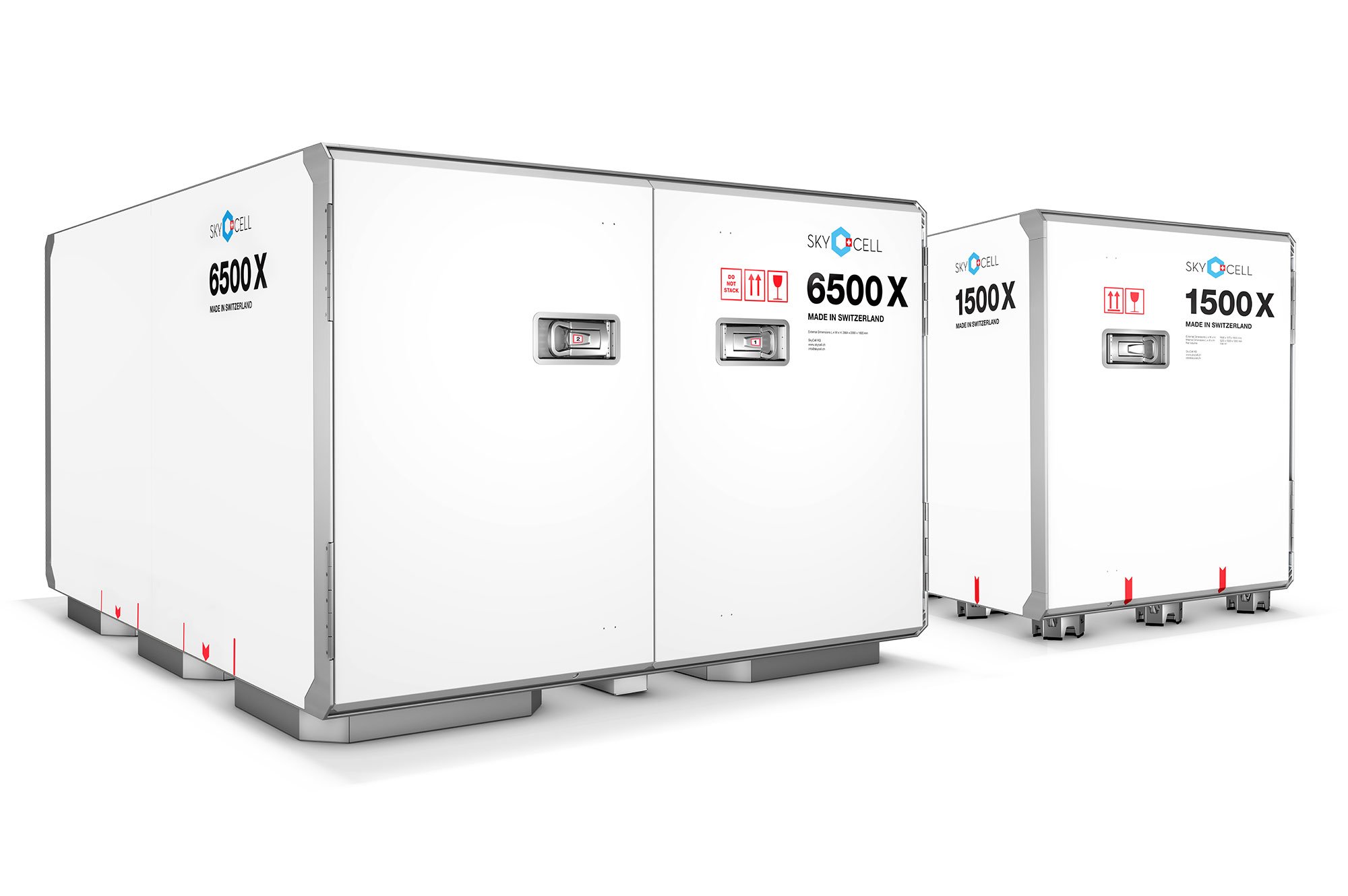
These runtimes are designed to absorb:
- Airport congestion
- Missed connections
- Customs delays
- Extended tarmac exposure
without relying on plugs or external power during transit.
Why Visibility And Intervention Matter
Visibility helps teams identify where excursions are likely to occur before they escalate.
Real-time monitoring allows logistics teams to:
- Detect prolonged dwell
- Locate delayed shipments
- Coordinate intervention early
SkyCell’s visibility infrastructure spans 250+ IoT-monitored airports, helping teams identify operational risk across global air freight hubs.
Coordinated (and predictive) intervention capability through Validaide then allows:
- Retrieval from tarmac exposure
- Rerouting
- Prioritized handling
before potential issues escalate.
Why Excursion Risk Is Increasing
Several pressures are making operational failure points more important:
- Growth in biologics and specialty medicines. IQVIA data cited by Alvarez & Marsal puts refrigerated products at 45% of novel active substance launches in 2018 to 2022, and projects 50% for 2023 to 2027.
- Airport congestion. Global air cargo passed 120 million tonnes in 2024, more than 8% above pre-pandemic levels, according to Airports Council International (ACI) figures reported by Air Cargo Week. The same article reports executives at multinational logistics firms estimating that dwell times at congested emerging market hubs run 20% to 30% higher than at comparable North American or European airports.
- Customs holds. A product classification that did not match the destination's import permit kept one vaccine shipment from Asia to Northern Europe under administrative review for nearly 48 hours, in a case reported by Air Cargo Week in 2026.
- Expansion into infrastructure-variable regions and emerging markets. In 2021, IQVIA projected that medicine spending in major pharmerging markets (China, Brazil, India, and Russia) would grow 7% to 10% a year through 2025, adding nearly $140 billion to global spending.
As these pressures build, the ability to tolerate disruption becomes increasingly important.
What This Means For Cold Chain Strategy
The most resilient pharmaceutical logistics systems are not those optimized only for ideal transit conditions.
They are systems designed for:
- Delays
- Variability
- Infrastructure gaps
- Real-world operational disruption
This requires combining:
- Long autonomous runtime
- Reduced infrastructure dependency
- Real-time visibility
- Coordinated and predictive intervention capability
rather than relying on a single control point.
Summary
- IATA reports that 50% of temperature excursions occur at airports, and the transitions around a flight carry the most risk
- Airport dwell, customs inspections, and handovers are the primary risk points
- Infrastructure dependency increases vulnerability during delays
- Runtime determines how long shipments can tolerate disruption safely
- Visibility and intervention reduce escalation risk
- Long-runtime systems with low infrastructure dependency perform more reliably on challenging lanes
Sources
- European Commission, Guidelines of 5 November 2013 on Good Distribution Practice of medicinal products for human use (2013/C 343/01), Chapter 9: Transportation.
- World Health Organization, Model guidance for the storage and transport of time- and temperature-sensitive pharmaceutical products, Technical Report Series 961, Annex 9 (2011).
- MHRA Inspectorate blog, A Practical example of applying Quality Risk Management in GDP – Transportation Risks, Terry Madigan, 15 July 2020.
- International Air Transport Association (IATA), Rethinking Supply Chain Control in the Digital Era, 2025 presentation.
- Alvarez & Marsal, Growth in the Biopharma Cold Chain Market, 2024, citing IQVIA, Global Use of Medicine 2023.
- Air Cargo Week, Cargo gridlock: Emerging market airports are running out of time, 9 February 2026.
- Air Cargo Week, The best laid plans: how pharma shipments can go wrong, Anastasiya Simsek, 15 April 2026.
- Patricia Van Arnum, The Global Bio/Pharma Market: Where's the Growth?, DCAT Value Chain Insights, 21 October 2021, citing IQVIA Institute, Global Medicine Spending and Usage Trends: Outlook to 2025 (April 2021).