Why Tracking Has Become Critical In Pharmaceutical Logistics
Modern pharmaceutical supply chains are increasingly complex.
Shipments may move through:
- Multiple airlines
- Freight forwarders
- Ground handlers
- Customs checkpoints
- Congested airport hubs
At the same time, biologics and specialty medicines have become more sensitive to operational disruption.
This means pharmaceutical companies increasingly need visibility into:
- Shipment location
- Temperature status
- Airport dwell time
- Delay risk
- Operational disruption across the journey
The goal is no longer simply to monitor shipments after problems occur. It is to identify risk early enough to intervene before excursions happen.
What Pharma Companies Should Look For In Cold Chain Tracking Systems
Real-Time Temperature Monitoring
Most pharmaceutical cold chain systems now include some form of temperature monitoring.
This helps companies:
- Verify compliance
- Detect excursions
- Monitor shipment stability during transport
However, not all systems provide the same level of visibility frequency, real-time access, or operational integration.
Live Shipment Location Visibility
Modern pharmaceutical logistics increasingly requires more than milestone tracking.
Companies are increasingly looking for:
- Full visibility
- Airport location tracking
- Geofencing alerts
- Delay detection during handovers
This becomes especially important during airport operations, where over 50% of excursions occur.
Airport Visibility Infrastructure
One of the biggest visibility gaps in pharmaceutical logistics is inside airport cargo operations.
Shipments may be:
- Delayed on tarmac
- Misplaced inside cargo warehouses
- Held during customs inspections
- Waiting for transfer between handlers
Traditional milestone tracking often cannot detect these operational risks quickly enough.
This is why some providers are now investing in dedicated airport visibility infrastructure.

Predictive Risk Monitoring
Tracking systems are increasingly evolving from passive monitoring tools into predictive operational systems.
Pharmaceutical companies increasingly look for capabilities such as:
- Delay prediction
- Lane risk analysis
- Excursion risk alerts
- Predictive ETA monitoring
- Operational anomaly detection
These capabilities help logistics teams respond proactively rather than react after thermal margin has already been lost.
Coordinated Intervention Capability
Visibility alone does not prevent excursions.
One of the most important differentiators between tracking systems is whether operational intervention can actually occur after risk is detected.
This may include:
- Retrieving shipments from hot tarmac
- Prioritizing delayed cargo
- Re-routing shipments
- Coordinating with airlines and ground handlers
Without operational coordination, visibility may identify problems without resolving them.
How Different Pharma Tracking Approaches Compare
Different pharmaceutical tracking systems provide very different levels of operational capability.
| |
|
|
| Capability Area |
Example Providers |
What It Typically Includes |
| Standalone Data Logging |
Sensitech, ELPRO |
Temperature recording and compliance reporting |
| Predictive Shipment Monitoring |
PAXAFE, Validaide |
Predictive risk alerts, ETA monitoring, and excursion analytics |
| Airline Shipment Visibility |
Airline cargo tracking platforms, SkyCell |
Shipment milestones and transport updates |
| Container-Integrated IoT Monitoring |
Envirotainer Releye, SkyCell containers |
Real-time temperature and location monitoring directly from the container |
| Integrated Operational Intelligence |
SkyCell + Validaide |
Combines container telemetry, airport visibility infrastructure, lane intelligence, and coordinated intervention capability |
As pharmaceutical supply chains become more operationally complex, many organizations are moving beyond standalone monitoring tools toward more integrated visibility and intervention models.
Why Visibility Matters Most During Operational Disruption
Most pharmaceutical temperature excursions occur during:
- Airport dwell
- Customs inspections
- Delayed handovers
- Infrastructure interruptions
- Ground handling delays
These events often happen between official shipment milestones.
This is why visibility inside operational environments is becoming increasingly important.
The ability to:
- Locate containers quickly
- Detect prolonged dwell
- Identify handling delays
- Coordinate intervention early
can significantly reduce excursion risk during biologics transport.
How SkyCell Combines Tracking, Visibility, And Operational Intelligence
SkyCell combines temperature-controlled containers with operational visibility and intervention infrastructure designed specifically for pharmaceutical logistics.
IoT-Enabled Container Monitoring
SkyCell containers continuously monitor:
- Temperature
- Location
- Handling conditions
This provides live operational insight throughout shipment journeys.
Airport Visibility Infrastructure
SkyCell’s visibility network spans:
- 250+ IoT-monitored airports
- 20+ airline partnerships
The network tracks over:
This infrastructure helps identify:
- Prolonged airport dwell
- Misplaced shipments
- Handling delays
- Exposure risk during operational disruption
across major pharmaceutical airfreight hubs.
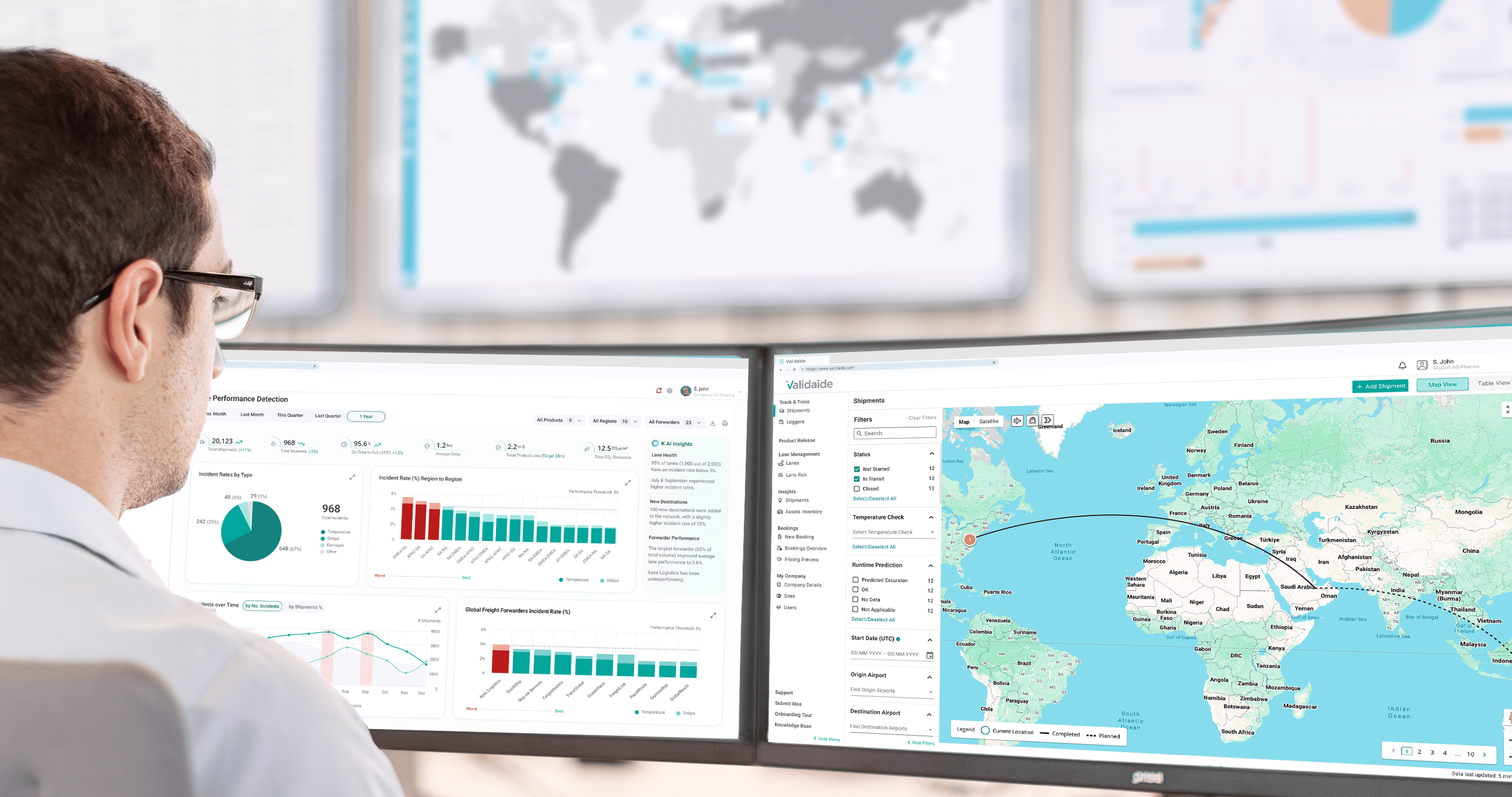
Lane Intelligence Through Validaide
Validaide provides:
- Lane risk analysis
- Supplier performance insights
- Emissions analysis
- Predictive logistics intelligence
The platform includes:
- 60,000+ digitized lanes
- 1,900+ connected logistics suppliers
This allows pharmaceutical companies to assess operational risk before shipments begin and improve route planning decisions.
Coordinated Intervention Capability
SkyCell combines monitoring with operational coordination.
When disruption occurs, the system supports:
- SOP-aligned intervention recommendations
- Airline coordination
- Ground handler communication
- Shipment retrieval and rerouting decisions
This reduces the time between:
- Risk detection
and
- Corrective action
which is critical for biologics and temperature-sensitive medicines.
Why Runtime And Visibility Work Together
Visibility is most effective when shipments also have sufficient thermal runtime to tolerate delays safely.
For example:
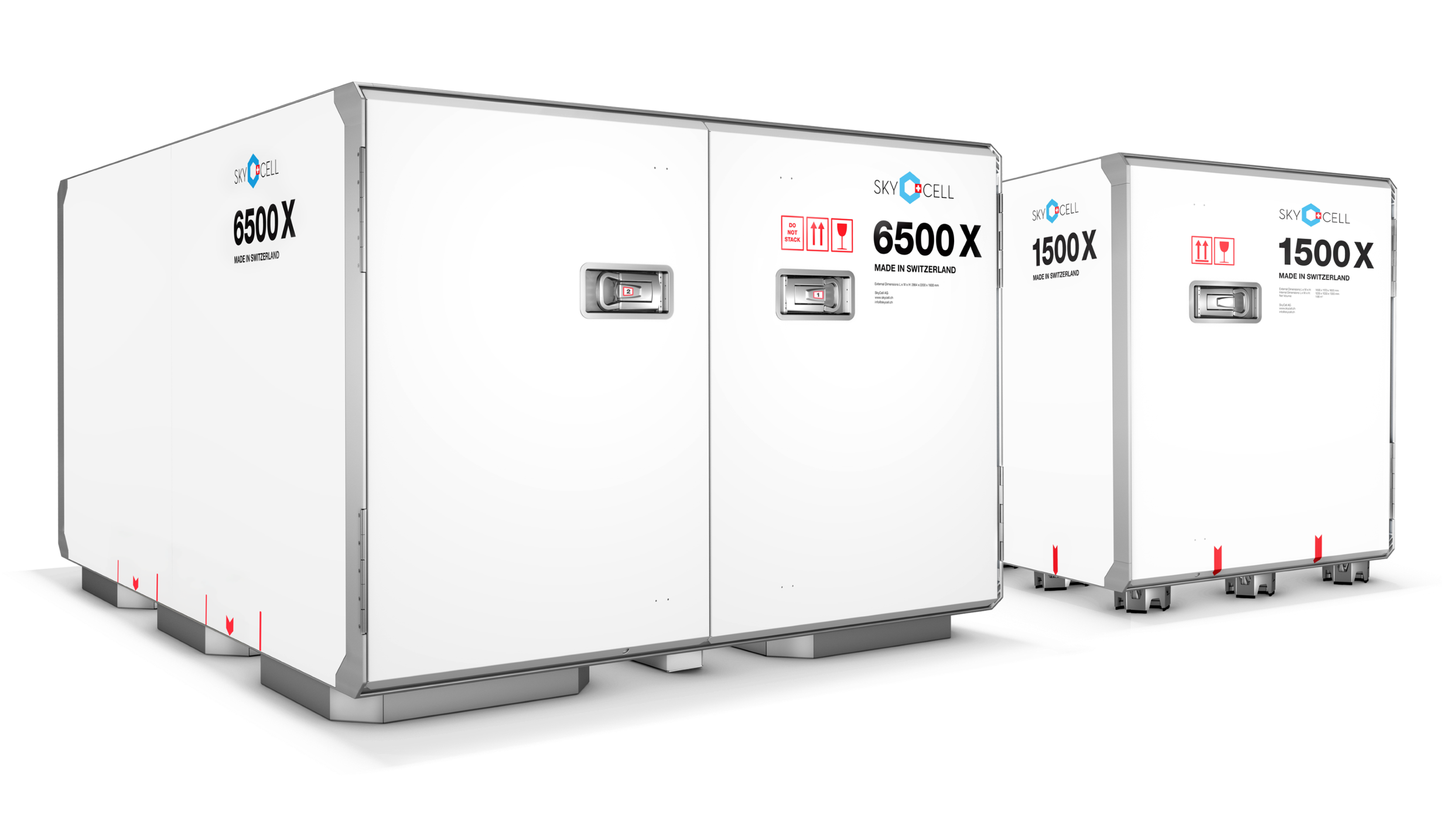
- The SkyCell 1500X provides 270+ hours of autonomous runtime
- The SkyCell 6500X provides 300+ hours of runtime
This extended runtime gives operational teams more time to:
- Detect disruption
- Coordinate intervention
- Prevent excursions before thermal protection is exhausted
Without sufficient runtime, even advanced tracking systems may not prevent product loss during prolonged delays.
Why Data-Driven Pharma Logistics Is Expanding
Several trends are increasing demand for operational visibility and intelligence:
- Growth in biologics and specialty medicines
- Increasing airport congestion
- More complex international logistics networks
- Higher regulatory expectations
- Greater focus on resilience and sustainability
As pharmaceutical supply chains become more operationally demanding, tracking systems are evolving from compliance tools into broader operational risk management platforms.
What This Means For Pharmaceutical Companies
The strongest pharmaceutical cold chain systems increasingly combine:
- Long-runtime temperature protection
- Real-time monitoring
- Airport visibility infrastructure
- Predictive analytics
- Lane intelligence
- Coordinated intervention capability
rather than relying only on standalone trackers or temperature logging.
Tracking alone does not prevent excursions. Operational visibility combined with response capability is increasingly what determines cold chain resilience.
Summary
- Pharmaceutical tracking systems vary significantly in operational capability
- Many systems provide monitoring, but fewer integrate visibility with intervention workflows
- Airport operations remain one of the largest visibility gaps in pharma logistics
- Predictive analytics and lane intelligence help reduce operational risk proactively
- Runtime and visibility work together to improve excursion resilience
- SkyCell combines IoT-enabled containers, airport visibility infrastructure, Validaide lane intelligence, and coordinated intervention capability into a broader pharmaceutical cold chain operating system